Showing posts with label creativity. Show all posts

20120813

remembering still feathers

Near the end of working on one side of the Good Bones remodeling project, a cedar waxwing crashed into a kitchen window.

It hit the window so hard that some of its feathers stuck to the glass of the window.

feathers left © 2011 Toni Matlock

feathers still © 2011 Toni Matlock

I turned to a fellow artist, Stephanie Frostad, for solace and she made a painting in honor of the sweet bird.

Hapless Waxwing © 2011 Stephanie J. Frostad
Stephanie currently has an exhibition of her art titled 'Natural Circumstances' on view in Seattle, Washington at Davidson Galleries until September 1st.  Be sure to visit the show in person if you can.

20120704

creative pollen between Smetanka and Rossellini

As a fan of Isabella Rossellini (especially her green porno series), I'm tickled to post her recent Burt's Bees project that includes animation by a local Missoula artist, Andy Smetanka.  Andy is a delightful, talented and positive artist in this community and the video is a clever and fun tribute to bees.

Enjoy!

20120302

from tomes to taps; getting your feet wet with apps

*The following article was previously published on young adult author Laura Elliott's website, Laura's Magic Day.  I met Laura at Wordstock in Portland last fall.  She is a super dynamic individual, so you should check her out.

So you are thinking about publishing an eBook?  Maybe you have a book in ink and paper already published and want to get in on all this App action.  Or maybe you haven’t been published yet, feel empowered by the self-publishing option and think the App rage looks like easy money.   Where do you start?  How easy or hard is it?

A few years ago my friend, artist and author Carol Bolt, called me up and asked if we at salty snack studios could and would make an App.  As a happy coincidence, my partner, Bruce Tribbensee, and I make movies and had just started making iPhone apps. Carol’s books were already on our list of apps we wanted to make.  And Carol was on our list of people with whom we wanted to work.

Carol has written and published several books starting with The Book of Answers™.   The Answers series began as a large one-of-a-kind hand-bound artist’s book.  Many people wanted to buy a copy.  She had it published and it snowballed into one playful theme after another (Movie, Love’s, Literary, Mom’s, Dad’s, Soul’s) in multiple languages and countries.  The books draw on the ancient wisdom of bibliomancy, the art of fortune telling through using a book. As a divination tool, it provides guidance to any yes-or-no question.  You hold the book closed and concentrate on your question. While visualizing or speaking your question, you stroke the edge of the pages. When you sense the time is right, you open to the page where your fingers landed and, “Voila!” There is your answer.  It’s simple, endless fun.

Carol is a warm and generous dreamer who makes whimsical drawings and sculptures and clearly enjoys the turn of a phrase. While I describe Carol as a dreamer, she’s also incredibly grounded with a deep reverence for objects and things made by hand.  Did I mention? She’s also a fantastic baker!  Her connection to books and their meaning could not be stronger.  Even so, her adventurous forward-thinking spirit led her (and us) into an exciting collaboration. 

And as for salty snack studios, we prefer to work on inventive projects that personally and creatively engage us and we welcome a challenge.  Working with artful people to help them manifest an idea is what we do.  I’m the Producer, guiding projects from their concept and design through production and onto the market.  My training is in art and I’m a compulsive organizer.   Bruce is also an artist with many years of experience computer programming.  He writes code in multiple languages, including for iPhone, Android and Blackberry.  He’s also an imaginative and fearless problem-solver.

What kind of App were we going to make?
The three of us set out to make an app for The Book of Answers™. We knew it would not be a proper eBook like you find on a Kindle or the like. We wanted to make a related but different experience to compliment the physical book. The app would be more than a sequence of virtual pages bound together inside a screen.  We spent months working through how the user interface would look and feel.  Bruce labored over the foundation, the motion and the function. We shared sketches, early design layouts and notes over the Internet.  Between Seattle and Montana, we spoke on the phone often. Frequently outside her technical comfort zone, Carol powered through and was in there with us the whole way open to change and suggesting new ideas.  

And we did it.  We built a native app with a resemblance to a book, with the look and feel of pages, but a book that you don’t properly read.  It has the essence of a book but is not an eBook. We used the mobile device’s ability to detect location so when you tilt the device, you get an illusion of weight and object-ness.  Sound effects heighten touch features. The interactive thumbing across a book’s end-pages fabricates a window into the ‘magic’ of the app.  We built something unique that we are all proud of and that compliments Carol’s printed works.

 What’s the moral of Carol’s app story so far?  To make an app, 1) you don’t have to be a geek, and 2) you can think of something new.  If you are starting with already published material, like Carol, it might be ideal to have an App that compliments your published material rather than duplicate it.  Even if you publish, digitally and/or in analog (ink and paper), you might want an app that expands the world of your book. The sky really is the limit.  If you can imagine it, someone can probably make it.  I’m not even exaggerating. 

First, what kind of app do you want to make?
Do you want an eBook, the digital equivalent of black and white print on paper?  Do you want an Enhanced book fitted with motion graphics, hyperlinks and interactivity?  Would a mobile-optimized website be enough for you? Or do you want a stand-alone native App that operates separately and differently than a book? Should you go DIY or hire someone?


Can you imagine your story’s ideas in motion, with sound? What about with gestures and interactive qualities?  What’s really hot right now are Enhanced Books.  Before you imagine the CD-ROMs of old, take a look at Enhanced Books. They have so much artful potential it’s mind-boggling. Like pop-up books, they maximize on the interactivity of their medium.  By integrating the power of touch screen with sound, motion and more, these books delight and demand one’s attention. The most compelling and visually stunning that I have seen so far is The Fantastic Flying Books. 

Can your story be a game?
Can you take the content of your book in new directions from printed words? Can you imagine the characters on an adventure or in a competition?  If so, a game App might appeal to you.  The entire mobile app world is still young and a bit like the Wild West.  The rules are still being made.  The most competitive app category is games but it’s also one of the most exciting and liberating.

What if I want to do it all myself?
Whether you are a novice or an established published author, I would first point you in the direction of iBooks Author.  I haven’t used it yet, but I took a peek and it looks super user friendly with enough features to have fun and potentially make something on your own that you would feel good about.  I’ve encouraged Carol to poke around in there too.  Honestly, once she got a taste for the creative possibilities with mobile technology, she’s become a wannabe geek monster! If you want to get started with the least amount of money to produce a simple eBook and you have plenty of time and energy to DIY, I say, “Go for it!”  Let me know how it goes for you, too!  Be sure to look at ‘pubit’ and other self-publishing tools, too.

The next question is arguably the biggest: what can you afford?  If I had a nickel for every pitch I’ve heard from people who think an app (or movie, but that’s another story) costs less than a thousand dollars to make.  The next part of that fantasy includes lounging on a beach while the dough rolls in. Don’t let those 99¢ price tags fool you.  To build an app from code up is not a cheap venture.  And know right now that what you consider ‘simple’ might not be so simple to make. A ‘brand quality’ native app costs at least $30,000 to design, code and launch.  If that knocks you back into a dusty library in shock, consider why you want the app in the first place.  If you are publishing yourself and you want to easily share your work with a young contemporary audience on the most popular platform of our time, 30 grand might be reasonable. Also keep in mind that maybe you don’t need a native app. Perhaps you can have a mobile-optimized website built for a bit less and it will fit your needs. Maybe iBooks Author or pubit software is plenty for you.  Explore your options.

Did you read the fine print?
Apple’s take is 30% of sales and so is Kindle’s. Barne and Noble’s ‘pubit’ takes more or less depending on the price of your book.  They are all operating somewhere between old school publishers and booksellers.  They give you a storefront, but they don’t help with editing, design and marketing. Conventional print publishers take upwards of 90% after an advance, and theoretically they promote your work.   It’s up to you to decide if their take is worth it or not.  Be sure to carefully read the contract.  It might say that you can’t take your material that you just published and put it on another platform. You wouldn’t be able to go from Apple to Android for example. I highly recommend that you have an intellectual property lawyer advise you so you understand your situation.

What is the best platform for my app?
An App on one mobile platform will not work on another.  You can’t simply plop the binary of an iPhone App into an Android.  They are completely different languages and the screen sizes for images are different dimensions.  Within Android devices, there are several screen sizes.  I’ll save the raging debate over which is better between Apple and Android for the tech sites.  The debate keeps shifting and both platforms are powerful.  Personally, I prefer the cleaner aesthetic of the iPhone but I also covet the larger real estate of some Android platforms.  If you can afford it, I suggest you do both.  If you can’t afford both, you just have to pick and not look back.     

What can I do to about discoverability?
There is a sea of apps and eBooks out there.  The App stores (for Apple and Android) are behemoth imprecise places.  It feels like you need an experienced librarian and a card catalog to guide you.  How do you get yours noticed?  Marketing Apps and eBooks is unpredictable and changing fast right along with technology.  If you can get your app in Apple’s App Store promotions, you’ll have significant results. Success stories come from all angles, not just the top down, so be patient and tenacious.  Ideally, you should hire a marketing person.  After you’ve invested so much in your work, don’t drop the ball now. Use all of the free marketing tools and social networking that the Internet makes available to you (Facebook, Twitter, Blogger reviews) and use the paid ones, too.  Advertise. Pull out all the stops as soon as you can. 

First steps to your App development:
1.     Do your research.  Study eBooks, enhanced books and game apps to understand the differences.  Get an idea of how your material could best be represented digitally.  You’ll probably discover many ways, which is exciting, so then decide what is the best one to start your App Adventure.  Make lots of notes and sketches of what you imagine your app could be.
2.     Figure out how much money you can spend.  Some people might say this should be the first step, but I recommend one dream first then roll up their sleeves.
3.     Build a team.  Find an App Developing Firm with people you trust, whom you can talk over ideas and with whom you feel comfortable.  Not every studio works as collaboratively as Bruce and I do, either.  Maybe you prefer to pass off the material and have someone get it done.  When shopping for your ideal App Dev team, the best might not be the biggest hipsters and the worst might not be the cheapest.  They just need to make a good match with you.
4.     Be open to change.  Show the team your sketches and notes but keep an open mind for different ideas.  There is no one way to make an App.
5.     Consult with an Intellectual Property Lawyer before you sign and submit your material to anyone – iBooks Author, Kindle, pubit! or app developers.
6.     Study Internet marketing and pay attention.  Spend time on different App review sites, and find reviewers that reflect your content and style.
7.     Make friends wherever you go (virtually and in reality.) 


Our collaboration with Carol was so satisfying that we went on to make The Love’s Book of Answers™ iPhone App with her and this year we will release an Android version of The Book of Answers™.  Look out, cause Carol has jumped head first into animation software and you’ll be seeing many more clever things out of her. 


Enjoy this short movie by one of our interns, Cassandra James, featuring The Love’s Book of Answers™ App.   


Want a few more details?

For more information on the costs and creativity with apps and eBooks, I recommend these:

3 Things no amount of code can fix. by Carisa Kluver, August 18, 2011

Are Reports of the Death of the Book App Premature? by Edward Nawotka, January 31, 2012

This is an excellent detailed article on the cost of app development and more:
The development of the typical app cost $35,000 and the median paid app earns $682 dollars per year after Apple took its cut.”
Full Analysis of iPhone Economics - it is bad news. And then it gets worse. June 22, 2010

9 Truths About ePublishing, Submitted by Emma Wright on Tue, 02/07/2012

The digitization of the music industry vs. the book world: the ultimate overview (part IV), Submitted by Timo Boezeman on Thu, 11/17/2011 http://futurebook.net/content/digitization-music-industry-vs-book-world-ultimate-overview-part-iv

What’s the difference between native apps and mobile-optimized websites?  See:

Is Developing a Mobile App Wirth the Cost? By Aaron Maxwell, Mashable, Feb. 24, 2011  http://mashable.com/2011/02/24/mobile-app-dev-cost/

Self-Publishing Services, Statistics and more links through Science Fiction & Fantasy Writers of America: http://www.sfwa.org/for-authors/writer-beware/pod/

Pricing and Payment Terms, Pubit! By Barnes & Nobles, http://pubit.barnesandnoble.com/pubit_app/bn?t=support


20120130

not too silly or wild

Friday Flicks:

This week's Friday Flick is really Flicks plural. I want you to know about Art Babble, a website of short videos designed to educate on specific paintings.  Many are specifically arranged for children to tour artworks from collections in different art museums and galleries around the country.  The analysis is pretty basic and a great way to encourage and compliment a youngster's interest in art (or yours).

For example, below is a video on on Post Impressionist, Vincent Van Gogh's 1889 self-portrait.


It's not all dead white guys either.  They also have some videos on some contemporary art and artists as well.  

Here is Polly Apfelbaum installing "Blossom."


Certain works are specifically part of the Children's Video Tour, like this one:
Jan Steen's "The Dancing Couple" from 1663.


The style of the educational videos vary in the editing, the verbal aspect - lecture vs. thought-provoking questions - and music, so if you don't like one, you may still like others.  You can select specific channels on Art Babble's website to help guide you in your interests, too. 

This Friday Flick is not too silly or wild for turning over a new year, but hey, it could be.   Who knows where it could lead?


20111231

pocket music

Technology pushes everyone around it seems, especially artists I often think because there is so much to keep up with, adapt to and compete with and artists are a culture's innovators. However, in the end I feel artists get the last word.

I'm not sure if it's a good thing or not but just as the piano evolved from dulcimers, our idea of what defines an instrument continues to change and include what began simply as a phone.   Mobile apps are redefining the idea of a music band and expanding our options to make music.  I haven't developed much of an ear for techno synthesized music yet, but I am pleased with the inventiveness of what people are doing to make music with what they are carrying in their pocket.  In some ways the technology levels the playing field, helping set a beat and letting someone without musical talent 'play' an instrument.  The spread of digital music is an undeniable fact, but for me reveals less about technology and more of the human desire to make art.   

Here is a video (2008) of iBand; two iPhones and a Nintendo D combine to play app instruments (apps by MooCowMusic) much like any band formed by using other instruments. 


What if you are rocking four iPhones?  Then you have the option of a one woman (or man) band like South Korean Kim Yeo Hee (a.k.a. Apple Girl). She can and does play 'real' instruments, too, as she does for "Half" with a full band and backup singers

Watch below as she covers Lady Gaga's "Pokerface" with only iPhone 'instruments' using T-Pain, Beatmaker and a fourth app that I could understand what she says (please help me translate if you can).


Here's a bit of Michael Jackson's Black or White on an iPhone using the app iShred. (Video by alychg 2011.)


Here is one more song with irony hopefully not lost, "Life Is Greater Than the Internet," also from iBand using two iPhones and an iPod Touch.


If you come across more music produced on the iPhone or the iPad (I didn't even start listing iPad songs but they are out there!), please share ones that you like with me. 

It will be interesting to see how the songs evolve with the assistance of mobile devices and how more artists own (or abandon) the medium.  Besides, I'm inspired by the ingenuity.

20111202

the lady and the duke

Friday Flick:

I'm not recommending Sony Classics' The Lady and the Duke (released in 2001) for its story or directing (by legendary Eric Rohmer) or cinematography or performances.  I couldn't even watch the movie in its entirety.  I fast-forwarded.  And that is something that I hardly ever ever do.  I force myself to sit all the way through even the dullest of movies before I judge it.  Sadly, I could not do it with this one.  The tales of an Englishwoman's affairs during the French Revolution appeal to me, but this film did not bring that story to life with any strength. I didn't even hang onto the copy of the DVD to revisit the movie at a different time when I might be more in the mood.  I popped it right back in the mail to FacetsAnd I feel vindicated for my disappointment by Stephanie Zacharek's review in Salon among others. 

All that said, I was attracted to the idea of using paintings as sets for a movie.  The painted backdrops have an impressive affect on time and motion, ripening it for sensuality and nostalgia.  In Roger Ebert's review, he describes it as, "a daring visual style in which the actors and foreground action are seen against artificial tableaux of Paris circa 1792. These are not "painted backdrops," but meticulously constructed perspective drawings, which are digitally combined with the action in a way that is both artificial and intriguing."  Unfortunately the action and story do not hold up to the set.  I don't really see how they could. Wow.  That's a hell of a set.  

In the end, even though the movie overall fell short for me, I'm grateful the French New Waver, Rohmer, experimented this way, especially so late in his career.  Apparently he was in his 80s when making the film.  He made something smart, elegant and tempting to the eyes that pushes the way we expect to see a motion picture.

To read more about the artist's thoughts when he, Jean Baptiste Marot, made the paintings for the movie and how they were incorporated technically (for example, note that the actors perform in front of green screens - not the actual paintings), follow this link.  


Sources:
SonyClassics.com
Salon.com
RogerEbert.com
Mubi.com
Facets.org 
Kamera.co.uk 
JeanBaptisteMorot.com


20111123

360 panorama

App on tap:

Bruce just introduced me to a very cool iPhone app called 360 Panorama.  You basically move the camera around while it takes frames of images and they get combined into one shot.  Voila! A 360 degree panoramic photo. Tons of potential for creative picture taking with this app.

If you see me around town spinning in circles with my phone in the air, I might be playing with this!

Bruce took this panoramic snap to show me how it works.  


Update 29 November 2011: 


Okay, Bruce took another photo that is pretty funny so I must add it here.


20111107

rauschenberg poetry

Being an artist:

Rauschenberg erased De Kooning.  The artwork became a classic almost instantly. 

I've always been struck with the simplicity and elegance of this artwork.  Period.  

When I listen to Rauschenberg tell how the work came about, I appreciate even more the strange competitive dynamic between many artists, even among the 'Masters'.  I love that Rauschenberg talked plainly of it and dealt with it for himself head on.

Hear him tell the story in the video below.


20111024

elizabeth murray

Being an artist:

Elizabeth Murray spoke at my graduation from the School of Art Institute in Chicago in the early 90s. While I appreciated her work then, I was not particularly a big fan or anything. However, when she spoke at our graduation ceremony, I felt more like I met her personally and found a deeper appreciation for her work.  I find this happens a lot in the arts.  Meeting the artist can - it doesn't always, but it can - give a new connection to the work.  Her positive and grounded attitude stayed with me.

Here is a trailer for the Elizabeth Murray movie by Art:21, a series of movies about artists produced by PBS.

20111021

el bulli

Friday Flick: 

If you love to cook, and if you also love art, you must watch this movie documenting the avant-garde cooking at a restaurant in Spain of the same name, El Bulli.  It's about the art of experiencing food. I'm still thinking about the water, the ice and the frequent obsessiveness that comes with creativity.  And the moments of absurdity and grace found in its pursuit.


As an aside, we saw El Bulli in Portland at the very comfy Living Room Theater.  We had just eaten dinner, so I only gobbled down a Lion Bar.  Next time I plan to enjoy a taste from their tapas menu and a glass of wine with my movie.


El Bulli is by archaeologist, language teacher, author and filmmaker, Gereon Wetzel.

20110521

a letter from Sol redux

                                                                            VXSP3PS3YT6H

Remember my post "a letter from Sol"?  Well, apparently Sol's letter is trending a bit.  That video was made in 2004 (according to its credits) and uploaded in 2007 by Joao Leonardo.  Here (below) is another video made by someone else inspired by the famed letter to Eva Hesse.  I found it via my friend and photographer, Doug Ness, who posted it on facebook and apparently picked it up from Jane Fulton Alt.  

Sheesh, the art world can be so... incestuously small and repetitive sometimes, eh?  Even so, I still maintain that every artist could use hearing this advice and repeatedly.  

Plus, I appreciate the different tone of this video.  Joao's is more minimalist and post-modern, in keeping with Sol Lewitt and Eva Hesse's sensibilities. This newer one (2011) by animator Levni Yilmaz is a refreshing departure; it is arranged differently, less intense in its energy, and incorporates hand-drawn imagery.  And the message feels more youthful and human because of it. 


To read the letter which begins "Dear Eva, It will be almost a month since you wrote to me and you have possibly forgotten your state of mind (I doubt it though)" in its supposed original content and order, go to this blog.

If you find more interpretations of Sol's letter out there, let me know. Perhaps I'll make my own video version of the letter.  Who knows?

20110513

waste land: vic muniz

Waste Land is simply a wonderful documentary that I think everyone should see.  Filmmaker Lucy Walker follows artist Vic Muniz from New York back to his homeland in Brazil to create an art project that incorporates materials picked out of the garbage with the help of workers at a massive dump.  The story is about more than art or the process of art or efforts to make change and because Muniz is such a positive character to follow, the sobering topic of poverty is handled with grace and often illustrates levity. 

Here is a link to the movie website. 

Here is a link to the movie on Netflix.

Watch the movie's trailer here:


20110418

a studio of one's own

A while back I received a letter in the mail notifying me that I had been nominated to an artist residency at Jentel by an art curator in Seattle whom I respect and admire.  The letter alone had me floating on air.  The residency had me hopping out of my skin.  (It still does.)  


At Jentel, I wandered around working in my head.


I wrote every day. I studied wind causes and patterns.  I watched a stack of avant-garde movies by  surrealists and early film experimentalists until I had a headache.  I read myself to sleep with novels at all hours of the night and short stories at breakfast. I listened to books on CD while making drawings.  I took leisurely walks, even if just to the mailbox.  I took many notes. I cut circles out of paper.  I made storyboards with ink, watercolor or graphite.  I sewed strips of black cloth into circles. 


I snapped  hundreds of photos.  


I just did stuff.   
 

I hiked with my video camera a couple times each week.  


I recorded the texture and movement of dry rattling grass and brittle sage shrubs.  


I edited video until I was dizzy. 


I followed the clouds and tried grabbing the sun.


While crawling around trying to get the better shot, I dragged my leg across a prickly pear cactus. (I don't recommend this.  I pulled at least 50 needles out of my calf and it's STILL bruised.)  Prickly Pears are low-growing and sometimes hidden in the grass, especially hard to see in late winter and early spring.  It's much easier to see in this picture, plus the cool crusty rock next to it.


I pondered the conical lava mound mountains. 


I revisited certain rocks.


I considered how each bit of scoria (lava rock) looks like a red, black or dark brown miniature mountain.  


Miniature scoria mountain.

And how it is sooo light.


I bound the scoria with string.


And hung them on the wall in the profile of the mountains outside on the other side of my studio wall.


T. Matlock, Lighten Up, Jentel scoria, nails and string.


T. Matlock, Lighten Up, angle view.

T. Matlock, Lighten Up, detail.

Finally, I cut them all down, cut away the threads and mixed them back into  the rest of the scoria gravel in the driveway.


Stay tuned for more about movies.  I'll be editing the video I collected for awhile.  


20110417

Jentel

Arriving on Lower Piney Creek Road in the middle of March
I just spent a month at Jentel, an artist residency, in Banner, Wyoming.  I lived in Wyoming twenty years ago and have a strong memory of the landscape and conditions there but I didn't have a solid visual for what the accommodations would be like at this residency, so for my fellow artists considering going, I hope this helps you prepare.  
 

I found Jentel to be a real treat, a place to rest and rejuvenate with the permission to do whatever I needed to do.  It was an excellent escape from my  routine of life and work.  While there, I abandoned my normal pressures and relaxed.  Even so, I was productive.  I revisited old ideas, tossing some out while refreshing others, and  I generated truckloads of new ones.  I tracked tangents to their end or folded them in.   I met my self-imposed technical  goals with this newer bigger faster camera enough to build my confidence and use it with more ease.  Plus, I made new friends that I expect to keep for a long time. 

In this post, I'll focus on the resident house, studio facilities and the setting.  

Jentel driveway paved and lined with scoria gravel and boulders.
Jentel office cabin.

Writer's Studio/Coup (2 studios).
Visual Art Studios (4 studios).
Front view of the residence when drive up.


Echo in the snow by the main entrance of the residence.
Mudroom with plenty of orange vests.
Residence foyer.
Kitchen.
Open kitchen and living room.
Living room and stairs.
I had the Hans Hoffman room.


The residence houses six artists with two wings, each with three bedrooms and two bathrooms, plus a half bath by the foyer.

I enjoy travel and a change of setting, so maybe in the end for me, home is where you hang your toothbrush?


Upstairs has a library and tv room.


Many details of the house have been thought out.  The house is well insulated so you don't hear your neighbors much or feel like the house is going to come down when the wind picks up.  Sturdy hooks, handles, laundry hampers (labeled by room no less) and generally smart house planning. 


And many pockets of light.


The studio space had everything I needed:  tables, a window, good lighting, a monster wall and lots of floor space and a sink.  It also had a bed that was a welcome comfort where I read more than expected.  (I brought my own big reading pillow but didn't really need it.)


In my mind, the big draw at Jentel is the setting.  

First, below is a view from the tippy top of the mountain directly behind the house and studio.  You can see that water wraps around the place, so when you walk from the house to studio you always hear running water and the birds, insects and toads it attracts.

Jentel is tucked into a bend in a river like an ideal campsite.

Never underestimate the drama of the constantly changing sky in Wyoming. 

Big rocks and big clouds.


The '1,000' is the vast property connected to Jentel available to resident artists to roam and explore.   A lot of the surrounding mountains (left photo) are cone-shaped dormant volcanic vents and stacks.  

Jentel is a working ranch.  Expect to see cowpies!
Important to pack:  If you like to hike, pack a windbreaker, hiking boots and clothes that can get muddy, stained and caked with red clay (especially in Spring), extra shoes or boots, a tick-repelling hat and warm layers and binoculars. For around the house, slippers are nice.

Wear orange vests for safety when you hike around Jentel.


The visual art studios in snow.
Amanda shoveled a path in the snow

While we were there mid-March to mid-April, birds were migrating north and it snowed a few times until Spring finally poked its way out.


Pheasant
See my post a studio of one's own for images of art I made while there. And Sheridan, Wyo for more notes on the area. (Both posts coming soon!)

Me, at the tops.

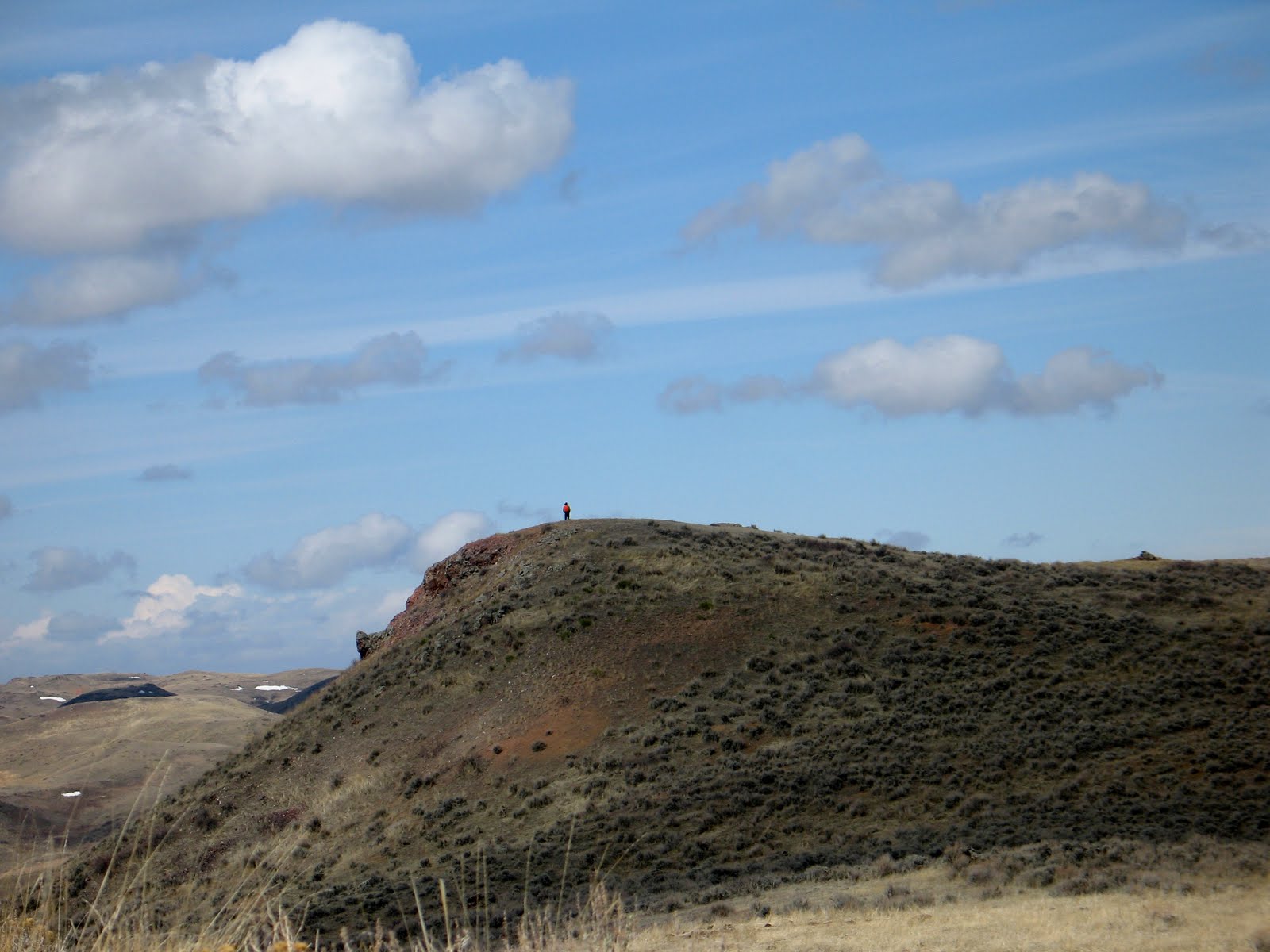
A fellow artist on another mountain.


Note: 
If you have also been to Jentel and have more tips to add, that would be great, please include them in the comments!  (Added April 18, 2011.)